
Agents and automation
Last updated
Can a local LLM run the house? Exposure scope and safety boundaries
Safety comes less from how smart the model is than from which devices you show it.
A local LLM1 interprets the sentence and proposes an action, but the Assist API2 in Home Assistant performs it. Safety therefore lives in the exposed list and the automation conditions, not in model quality. This guide covers leaving risky devices out and starting with reversible actions.
The model proposes; Home Assistant executes
The conversation model reads the sentence and decides which device to act on and how. That decision does not flip the switch by itself: Home Assistant executes through the Assist API, only for exposed entities.
Changing the model leaves the risk surface unchanged. Widening the exposed list raises risk even with a weaker model. The knob for safety is the list, not the model.
- Adding an Ollama conversation agent to Home Assistant: exposed entities and instructions
- Running local AI for a smart home: splitting voice, conversation and video across your own machines
- What Is a Local AI Agent? When It Makes Sense to Run One
- A morning brief from Home Assistant: turning sensor data into sentences with a local LLM
- Raising local LLM voice command accuracy: aliases, exposure and instructions
What to leave out, what can stay
Leave locks, garage doors, heaters and fans off the exposed list; a wrong action can injure someone or damage property. Sensors only report values, so exposing them first carries little risk.
A light or switch left on can simply be turned off again. Start with one room's lights and widen as the phrasing works.
Start with actions you can undo
Locking a door and turning on a light fail differently. Undoing the first needs a key or a code; undoing the second needs one more sentence.
Automations can wrap the action. If the model asks for 'turn everything off at night', the automation turns off only the listed devices and leaves the rest alone.

Closing the paths out of the house
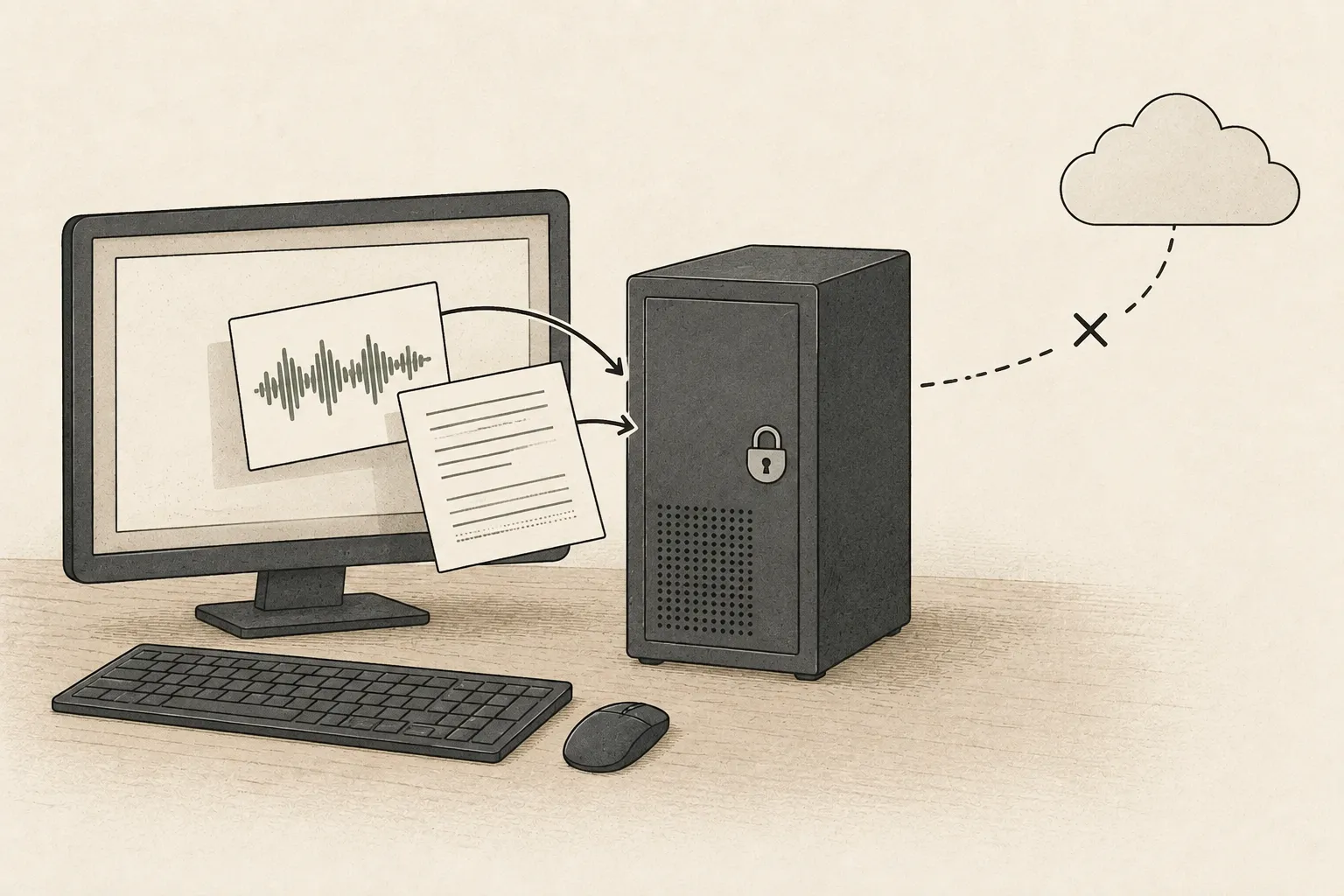
A local model keeps questions inside. An external API model sends the sentence and device state to that server. Check settings for which one you run.
Voice services connected over Wyoming3 have no authentication. Keep them on a trusted home network and do not open their ports on the router.
Decide the default when it fails
For the moments a model answers oddly or not at all, keep critical actions on sentence triggers. Turning off lights keeps working even with the model down.
Keep a record of what ran. The log shows which sentence moved which device, and if an odd action repeats, remove that device from the list.

Terminology notes
Large language model — A model trained on large text datasets to learn language patterns and process or generate text in context.
Back to the textAPI — A defined interface that lets other code call a program’s functions.
Back to the textWyoming — The protocol Home Assistant and voice services use to exchange audio and text. It has no authentication or encryption, so it is used on trusted networks only.
Back to the text
Frequently asked questions
- What should you check first in this article?
- A local LLM interprets the sentence and proposes an action, but the Assist API in Home Assistant performs it. Safety therefore lives in the exposed list and the automation conditions, not in model quality. This guide covers leaving risky devices out and starting with reversible actions.