
new model · 2026.10.23
Last updated
KRAFTON Raon-1 mini local LLM: a Korean 30B MoE on one RTX 5090 32GB
A Korean-built model you can try on a single RTX 5090 with 32GB
Raon-1 mini is a 30B-A4B MoE1 model that KRAFTON AI trained from scratch for Korean and agentic work. Of 30B total parameters, 4B are active per token2, and the context reaches 262,144 tokens. It was trained on Korean, English, Japanese, Chinese, Spanish, French and Thai. The model card states that NVFP43 quantization4 lets it run on a single RTX 5090 with 32GB. It is a preview release rather than the final model, and you must request access on Hugging Face before downloading.
Trained from scratch with Korean in mind
Raon-1 mini is a 30B-A4B MoE language model that KRAFTON AI designed and trained from scratch. The 30B is the total parameter count and A4B means about 4B active per token. The model card describes strong performance in Korean conversation and agentic tasks. It is trained in-house rather than fine-tuned from another open model.
Its training languages are Korean, English, Japanese, Chinese, Spanish, French and Thai. The model card describes strong Korean and solid English. For Korean users, Korean appearing among the training languages matters by itself. How much training weight each language received is not published, so verify Korean quality directly.
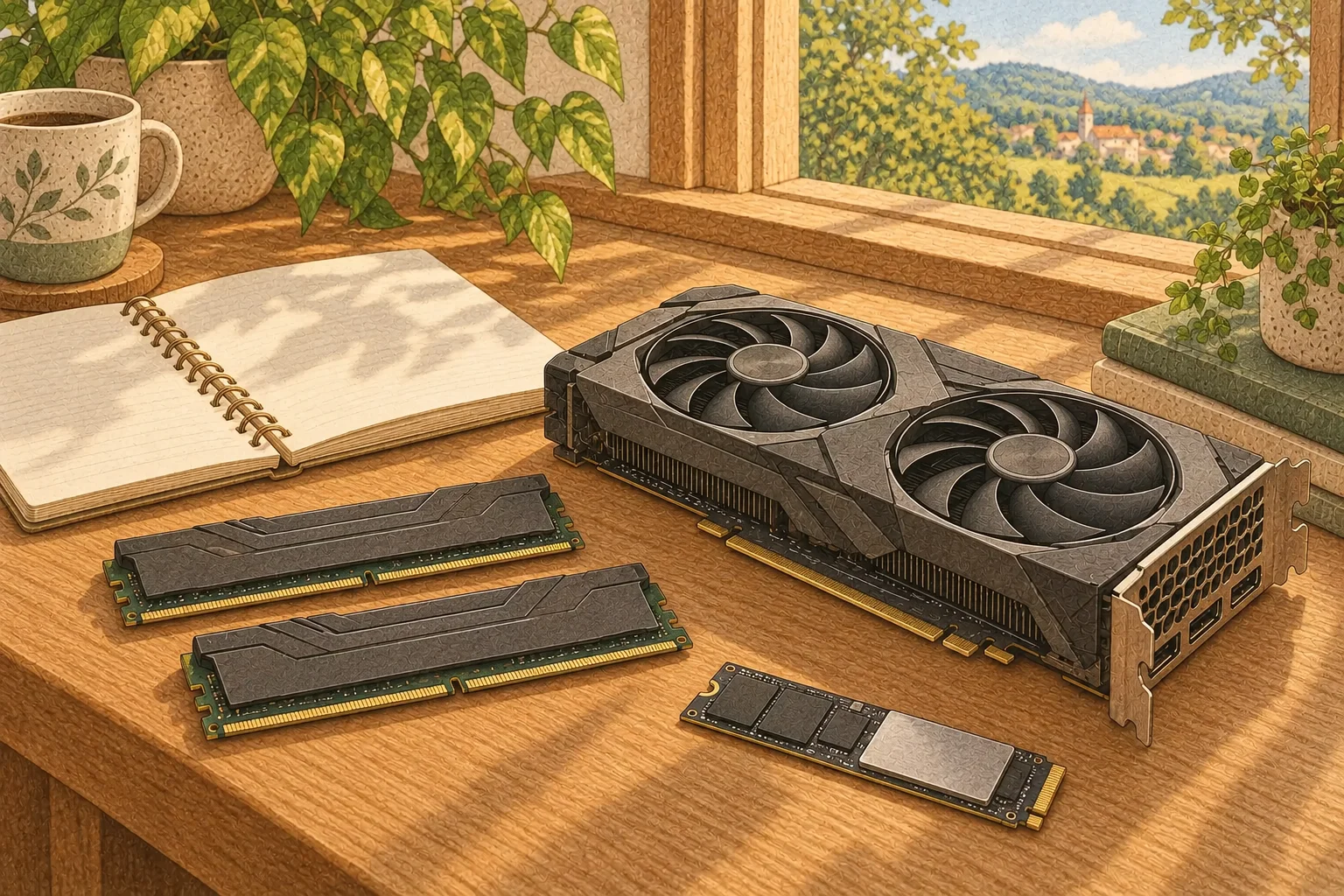
This model matters for Korean users because it is a Korean-built model with Korean in its training data. If you are looking for a Korean local LLM5, a single RTX 5090 with 32GB is enough to try it first.
A changed attention layout reduces the cost of long context
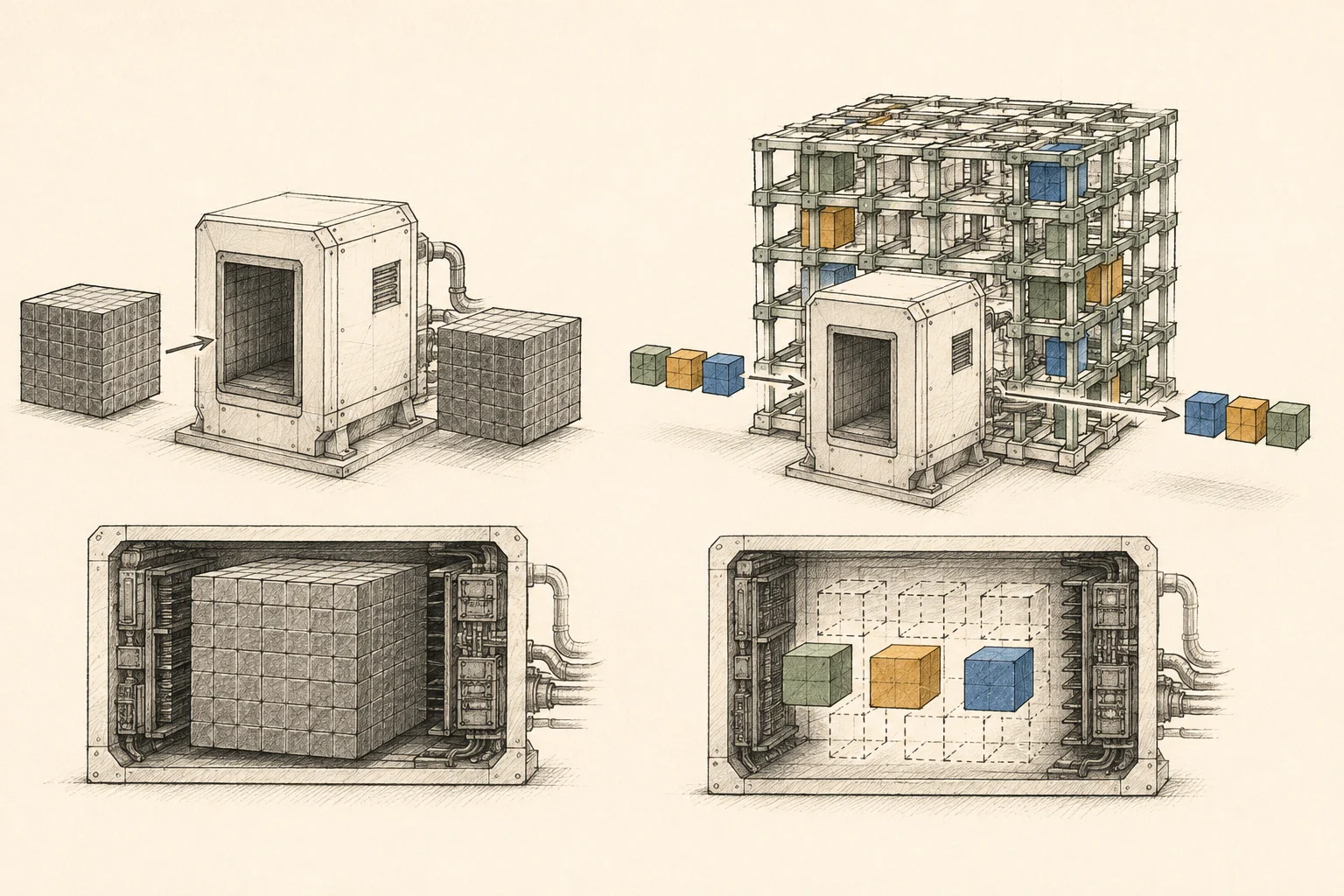
Of its 25 layers, 18 use Raon Delta Attention6 and 7 use MLA. The linear-attention RDA layers hold a fixed-size state, so the KV cache7 does not keep growing as input lengthens. Only the 7 MLA layers keep a cache, and the model card states roughly 8 KiB per token in BF168.
For long-context work this makes memory use easier to predict. It only helps if the runtime9 supports this attention layout, though. Check when llama.cpp, Ollama or vLLM added support before choosing a file.
Request access first, then choose a file
This model is not downloadable straight from the Hugging Face repository. You fill in your name, affiliation, job title, country and intended use, and agree to the licence. After approval you can fetch the model files and the GGUF10 or MLX11 conversions. Approval is not automatic, so allow time for the first attempt.
Once you have access, pick the format that matches your use. Target a single RTX 5090 and the NVFP4 file is the one the model card points to; prefer compatibility and simpler tooling and GGUF is the choice. MXFP8 is also offered. Each format needs different memory and runtime support, so the same model does not mean the same running conditions.
Treat preview status as part of how you read results
The model card states that this release is not final and that specifications and results may change before the finished version. The benchmark tables are preview figures too. If a final release under the same name appears in a few weeks, scores and recommended hardware may differ, so record the version and measurement date before putting it into work.
The comparison table places Raon-1 mini beside Qwen3.6-35B-A3B, Gemma 4 26B-A4B, Qwen3.8-27B and Muse Glimmer 30B. Sharing a table does not prove the measurement environments match, so verify that separately. Some knowledge benchmarks are lower than rivals, so read them alongside the reasoning, instruction-following and agentic results the release highlights.
For Korean document work, it is worth comparing early
What makes this model interesting for Korean users is that a model with Korean in its training data can be tried on RTX 5090-class hardware. For work where Korean input is the point, such as meeting summaries, internal document triage or Korean customer replies, it is worth comparing against the Qwen or Gemma models you already use on identical sentences.
Conversely, if your work is only English code writing or long English documents, there is little reason to pick this model first. Switch only when a comparison on the same memory shows an advantage over a model you have already validated. Keep a preview model as a candidate for testing rather than a work baseline.
Check the Apache 2.0 terms
Raon-1 mini is released under the Apache 2.0 licence. Commercial use, modification and redistribution are allowed with no revenue threshold. The access gate is a distribution method, not a narrower licence. Apache 2.0 does require keeping copyright notices and marking changes, so retain the licence and NOTICE when embedding it in a product.
Terminology notes
MoE — A model architecture that selects some of several expert subnetworks for each input. Total parameters can differ from the number activated for one token.
Back to the textToken — A unit into which a model divides input or output for processing.
Back to the textNVFP4 — A 4-bit floating-point data format defined by NVIDIA. Support depends on GPU generation, model, and software implementation.
Back to the textQuantization — A way to represent model weights or values with fewer bits, reducing storage and memory use. The coarser representation can also affect accuracy.
Back to the textLarge language model — A model trained on large text datasets to learn language patterns and process or generate text in context.
Back to the textAttention — A neural-network operation that calculates relationships between input tokens and combines information from each position into the current representation.
Back to the textKV cache — Memory that stores attention keys and values from earlier tokens for reuse during later token generation. Its size depends on context length and batch size.
Back to the textBF16 — A 16-bit floating-point format for model values. Its exponent has the same width as FP32, giving it a similarly wide value range.
Back to the textRuntime — The software environment that provides facilities needed while a program runs. In local AI, it can also refer to a model execution engine.
Back to the textGGUF — A file format for model data, widely used by llama.cpp-based tools.
Back to the textMLX — Apple’s machine-learning framework, which runs models using memory shared by the CPU and GPU on Apple Silicon.
Back to the text
Frequently asked questions
- What should you check first in this article?
- Raon-1 mini is a 30B-A4B MoE model that KRAFTON AI trained from scratch for Korean and agentic work. Of 30B total parameters, 4B are active per token, and the context reaches 262,144 tokens. It was trained on Korean, English, Japanese, Chinese, Spanish, French and Thai. The model card states that NVFP4 quantization lets it run on a single RTX 5090 with 32GB. It is a preview release rather than the final model, and you must request access on Hugging Face before downloading.
- How much memory does it need?
- For long-context work this makes memory use easier to predict. It only helps if the runtime supports this attention layout, though. Check when llama.cpp, Ollama or vLLM added support before choosing a file.
- Where can you check the conditions and sources?
- Its training languages are Korean, English, Japanese, Chinese, Spanish, French and Thai. The model card describes strong Korean and solid English. For Korean users, Korean appearing among the training languages matters by itself. How much training weight each language received is not published, so verify Korean quality directly.