
new model · 2026.10.23
Last updated
LFM2.5-24B-A2B local LLM: a Korean-capable 24B MoE on your own PC
A 24B MoE with Korean support that runs on Macs and NVIDIA PCs
LFM2.5-24B-A2B is a reasoning model Liquid AI released on 12 October 2026. Its mixture-of-experts structure routes each token1 through 4 of 64 experts, so the weights occupy 24B while a single token costs roughly 2.45B of computation. It supports 16 languages including Korean, and the official GGUF2 and MLX3 4-bit files mean both Macs and NVIDIA PCs can run it. The 184 tok/s in the model card was measured on an Apple M5 Max, so do not read it as your machine's speed.
The file is 24B; the computation is 2.45B
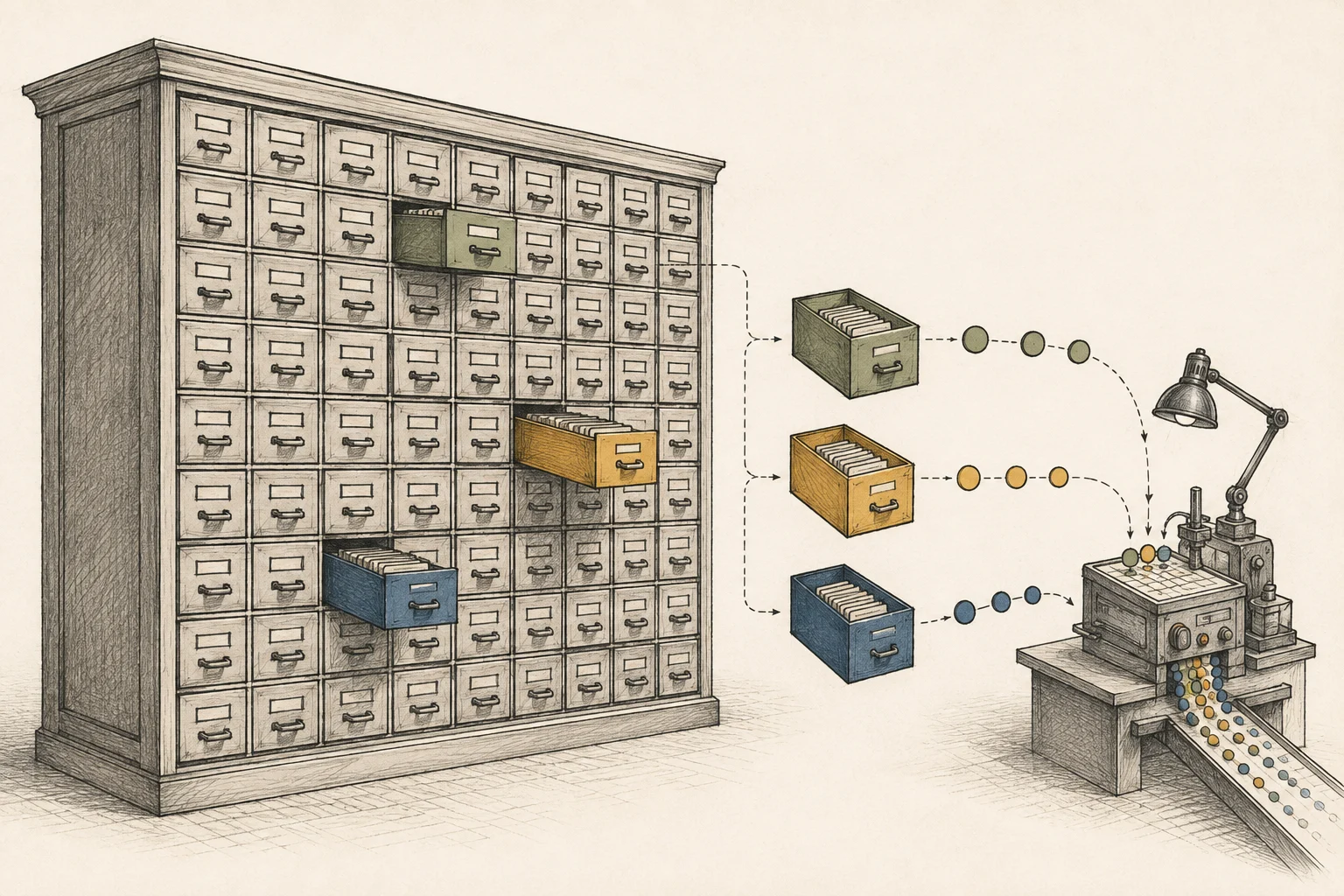
LFM2.5-24B-A2B is a text reasoning model that takes a question and produces an answer. The 24B in the name is the total parameter count the model carries; A2B means roughly 2B parameters are active for each token. The model card states 2.45B active parameters. Of its 40 layers, 30 use short convolution blocks and 10 use standard attention4, and each MoE5 block selects 4 experts from 64.
What makes this practical is that memory and speed move separately. Loading the model needs space for 24B of weights, but token throughput6 stays close to the compute of 2.45B active parameters. Compared with a dense 24B model it should produce more tokens from the same memory, while a 7B-sized budget cannot hold it at all. That is why both numbers matter.
If you are looking for a local LLM7 that supports Korean, separate the language list from actual Korean quality. This model lists Korean among 16 languages, and it also defines the scope of free use.

It supports 16 languages, including Korean
The model card lists English, Arabic, Chinese, French, German, Italian, Japanese, Korean, Portuguese, Spanish, Vietnamese, Thai, Indonesian, Hindi, Russian and Polish. Korean appearing in that list matters for Korean users. The list means the language was in training data, though, not that Korean quality matches a 24B model built specifically for Korean.
Choose the weights that match your hardware
The official repositories publish the same model in several formats: the native checkpoint8 for Transformers, vLLM and SGLang, block-wise FP89, GGUF, ONNX, and a 4-bit MLX build for Apple Silicon. Choose GGUF to run it in llama.cpp or Ollama, and the 4-bit MLX file when you use MLX-based tools on an M-series Mac. The two cannot be swapped.
File sizes differ sharply by format. The 4-bit variants are smaller than the original weights, and quantization10 changes both answer quality and speed. Note which file you used for the first run so you can keep conditions equal when comparing formats later.
Separate the vendor's measurement from your own speed
The model card states it runs up to 1.7 times faster than comparable MoEs, reaching 184 tok/s on an Apple M5 Max and up to 21K output tok/s on a single NVIDIA B300. Those figures come from conditions the vendor chose. To read them against your own machine, first match the hardware, the quantization file, the context length11, and whether thinking tokens counted toward the output.
Because this is a reasoning model, thinking tokens appear before any answer. To compare perceived latency, time the arrival of the first answer and the completion separately. Whether thinking tokens count in the output changes the second number substantially.
Built for agents, not for knowledge questions
The model card recommends it for agents that reason and call tools, not for knowledge-heavy tasks on its own, and suggests pairing it with retrieval or web search. Work that already has source documents, such as meeting summaries or internal document search, plays to its strengths when combined with RAG12.
Public benchmarks appear in both the vendor blog and the model card. When comparing against rival scores in the same table, check that the evaluation conditions match. Tool-use benchmarks shift with prompts13 and runtime14, so trying your own work sentences once is more reliable.
Check the licence and runtime conditions
The licence is not a standard open-source one but Liquid's own LFM Open License v1.0. Personal and research use is unrestricted, while commercial use is conditional. Commercial use is permitted while annual revenue stays below 10 million US dollars, and above that threshold you need separate permission. The licence defines this as the Threshold and conditions the commercial grant on not exceeding it.

Terminology notes
Token — A unit into which a model divides input or output for processing.
Back to the textGGUF — A file format for model data, widely used by llama.cpp-based tools.
Back to the textMLX — Apple’s machine-learning framework, which runs models using memory shared by the CPU and GPU on Apple Silicon.
Back to the textAttention — A neural-network operation that calculates relationships between input tokens and combines information from each position into the current representation.
Back to the textMoE — A model architecture that selects some of several expert subnetworks for each input. Total parameters can differ from the number activated for one token.
Back to the textThroughput — The amount of work processed or generated over time. Comparisons need the unit, such as tokens per second or requests per second.
Back to the textLarge language model — A model trained on large text datasets to learn language patterns and process or generate text in context.
Back to the textCheckpoint — A file containing saved model weights and related state. Versions or tasks in one model family may use different checkpoints.
Back to the textFP8 — A floating-point format that represents each value with 8 bits.
Back to the textQuantization — A way to represent model weights or values with fewer bits, reducing storage and memory use. The coarser representation can also affect accuracy.
Back to the textContext window — The token span of input and generated content a model can handle in one request. The supported limit and memory use depend on the model and runtime settings.
Back to the textRetrieval-Augmented Generation — A method that retrieves material relevant to a query, adds it to the model input, and generates an answer from that context.
Back to the textPrompt — The input text sent to a model. For generative models it describes the desired result and strongly shapes the output.
Back to the textRuntime — The software environment that provides facilities needed while a program runs. In local AI, it can also refer to a model execution engine.
Back to the text
Frequently asked questions
- What should you check first in this article?
- LFM2.5-24B-A2B is a reasoning model Liquid AI released on 12 October 2026. Its mixture-of-experts structure routes each token through 4 of 64 experts, so the weights occupy 24B while a single token costs roughly 2.45B of computation. It supports 16 languages including Korean, and the official GGUF and MLX 4-bit files mean both Macs and NVIDIA PCs can run it. The 184 tok/s in the model card was measured on an Apple M5 Max, so do not read it as your machine's speed.
- How much memory does it need?
- What makes this practical is that memory and speed move separately. Loading the model needs space for 24B of weights, but token throughput stays close to the compute of 2.45B active parameters. Compared with a dense 24B model it should produce more tokens from the same memory, while a 7B-sized budget cannot hold it at all. That is why both numbers matter.
- Where can you check the conditions and sources?
- The model card states it runs up to 1.7 times faster than comparable MoEs, reaching 184 tok/s on an Apple M5 Max and up to 21K output tok/s on a single NVIDIA B300. Those figures come from conditions the vendor chose. To read them against your own machine, first match the hardware, the quantization file, the context length, and whether thinking tokens counted toward the output.