Executable programs and extensions
What is Jev? A System One model that decides instead of writing
Hearing that Jev is fast can make it sound like a small LLM that writes shorter answers. It is a different kind of tool. Software defines the possible outcomes, and the model returns a choice plus probabilities rather than a long explanation. That shape is useful when routing tickets or checking policies thousands of times. Start by separating this decision layer from a writing assistant.
The request is shaped differently
A chat model receives a situation and an open question. A Jev request also declares the decisions and allowed answers. A support message might be routed to billing, access or security, while a policy check might be limited to yes or no. The response is a typed value with probabilities and confidence, not prose written for a person. The point is to hand the next piece of software a value it can use immediately.

Why it can be fast
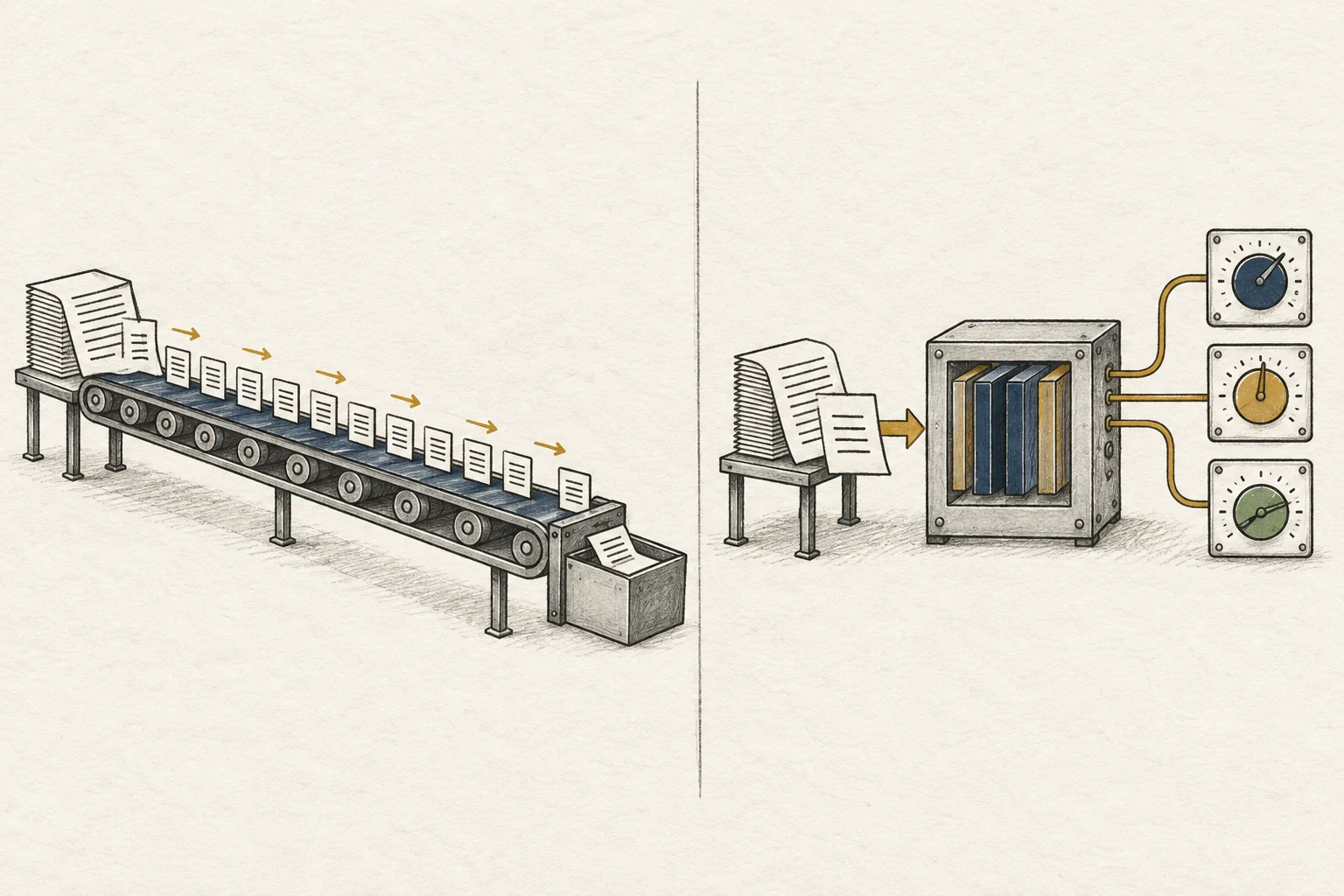
An LLM that emits JSON still writes braces, keys, values and explanations one token after another. Even a compact object can require many sequential forward passes. Jev knows the output shape in advance and evaluates multiple decisions in parallel. TypeSafe describes end-to-end latency for its service in a 70–500 ms range, but that is not a universal promise for every region and request. Input length, decision count and network conditions still have to match before comparing systems.
Typed output is not a truth guarantee
Keeping the response inside a declared schema removes malformed JSON and invented keys, which matters in automation. It does not make every choice correct. Ambiguous text and unfamiliar business rules can still be misread, and a wrong option can receive high probability. Before deployment, define the cost of an error and route low-confidence cases to a person or a conventional rule. Type safety and decision accuracy should never be treated as the same claim.
Where this shape fits
Classification, routing, risk scoring, ranking and support checks fit because the answer space can be declared in advance. A shared document can be checked against many rules, or a request can be sent to one of several tools. Writing a report, editing code and explaining a decision still require free-form generation. In those workflows, a Jev-like decision layer can sit before or after an LLM to route work or check outputs. Treating either system as a complete replacement for the other misses the useful boundary.
What local projects do and do not reproduce
TypeSafe has not released Jev's weights or training recipe. Recent local projects use open Qwen checkpoints, read option-token logits, or prefill a shared document once before branching into many questions. They reproduce parts of the interface and execution pattern, not the undisclosed Jev model. Speed, accuracy and probability calibration therefore need separate validation for each project. The next guide separates the laptop-sized experiments from the server implementations.